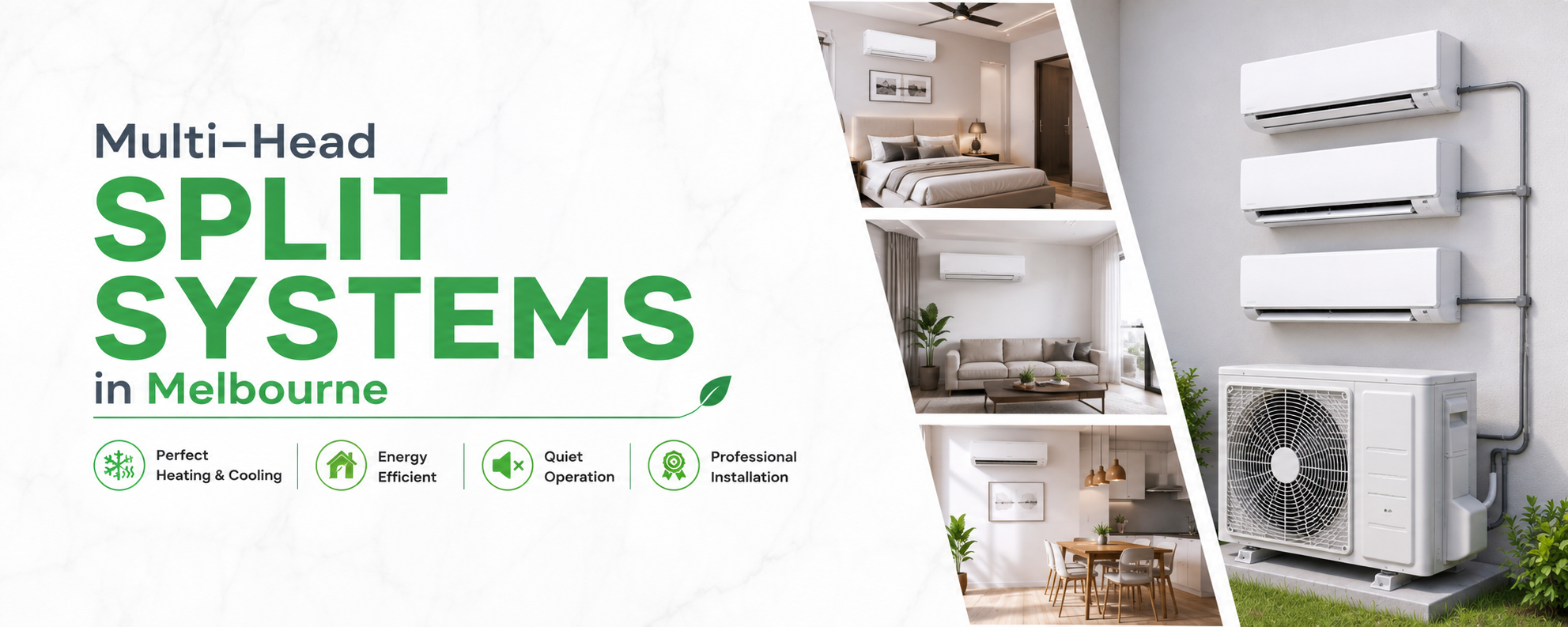
Multi-Head Split Systems in Melbourne
A multi-head split system allows you to heat and cool several rooms using one outdoor unit connected to multiple indoor air conditioners.
It can be a practical alternative to installing several separate outdoor units or adding ducted air conditioning, particularly in townhouses, units, renovated homes and properties with limited roof or outdoor space.
Smart Energy Technologies supplies and installs multi-head reverse-cycle air conditioning systems in Ferntree Gully and across Melbourne’s eastern suburbs. We also help eligible Victorian customers understand discounts available through the Victorian Energy Upgrades Program.
Call: 03 7044 8168 | WhatsApp: 0481 846 175
Location: Unit 42, 756 Burwood Highway, Ferntree Gully VIC 3156
What Is a Multi-Head Split System?
A multi-head split system, also called a multi-split air conditioner, connects two or more indoor air conditioning units to a single outdoor compressor.
A standard split system usually has:
- One indoor unit
- One outdoor unit
A multi-head system has:
- One outdoor unit
- Multiple indoor units positioned in different rooms
Depending on the selected model and system capacity, one outdoor unit may support two, three, four or more indoor units.
Each indoor unit normally has its own controller, allowing household members to switch individual rooms on or off and select a preferred temperature.
Most residential multi-split systems must operate in the same overall mode. This means connected rooms can generally be heated at the same time or cooled at the same time, but one room cannot usually be heated while another is being cooled.
How Does a Multi-Head Split System Work?
A multi-head system transfers heat between the indoor units and the outdoor unit using refrigerant pipes.
In cooling mode, the system removes heat from inside the home and releases it outside. In heating mode, the reverse-cycle system extracts available heat from the outside air and transfers it indoors.
The outdoor unit distributes its available capacity between the indoor units that are operating. If several rooms are running simultaneously, the system shares its total output between those rooms.
This is why professional system sizing is important. Choosing a system based only on the number of indoor units can result in poor comfort, unnecessary expense or inefficient operation.
A proper assessment should consider:
- Room dimensions
- Ceiling height
- Window size and orientation
- Insulation
- Sun exposure
- Number of occupants
- How frequently each room is used
- Local climate conditions
- Simultaneous heating and cooling demand
- Outdoor unit location
- Refrigerant pipe distances
- Electrical and switchboard capacity
Where Can Indoor Units Be Installed?
Depending on the selected brand and system, a multi-head installation may use:
- Wall-mounted indoor units
- Compact cassette units
- Floor-mounted units
- Concealed bulkhead units
Wall-mounted units are the most common choice for residential properties because they are generally efficient, accessible and easier to install.
The available combinations depend on the outdoor unit, indoor unit capacities and manufacturer specifications.
Benefits of a Multi-Head Split System
Heat and Cool Multiple Rooms
One system can provide reverse-cycle heating and cooling to several bedrooms, living spaces or home offices.
One Outdoor Unit
Connecting several indoor units to one outdoor unit reduces the number of outdoor compressors required around the property.
This can be valuable where space is limited or where several outdoor units would affect the appearance or usability of the home.
Individual Room Control
Indoor units can normally be controlled separately. You can switch off rooms that are not in use instead of conditioning the entire home continuously.
No Central Ductwork
Multi-head systems do not require extensive ceiling ductwork. This makes them suitable for some homes where roof access is limited or ducted installation would be difficult.
Heating and Cooling in One System
Reverse-cycle technology provides cooling during summer and efficient electric heating during winter.
Flexible Indoor Unit Selection
Compatible indoor units can be selected according to the size, use and layout of each room.
Limitations to Consider
A multi-head system is not automatically the best option for every property.
Shared Outdoor Capacity
The outdoor unit has a fixed total capacity. When several indoor units operate simultaneously, that capacity is distributed across the active rooms.
One Common Operating Mode
Most residential systems cannot heat one room while cooling another room at the same time.
One Outdoor Unit Is a Shared Component
If the outdoor unit experiences a fault, all connected indoor units may be affected.
Installation Can Be Complex
Multiple refrigerant lines and condensate drains must be routed between the indoor and outdoor units. Long or difficult pipe runs can increase installation cost.
It May Not Always Cost Less Than Ducted Air Conditioning
For two or three rooms, a multi-head system may provide a practical alternative to ducted air conditioning. As the number of rooms increases, the total equipment and installation cost may become comparable to a ducted system.
Both options should be assessed before choosing a whole-home solution.
Multi-Head vs Multiple Single-Split Systems
| Feature | Multi-head system | Separate split systems |
|---|---|---|
| Outdoor units | One shared unit | One outdoor unit per room |
| Indoor control | Individual room control | Individual room control |
| Outdoor space required | Lower | Higher |
| Shared system capacity | Yes | No |
| Effect of outdoor-unit failure | May affect every connected room | Usually affects one room |
| Installation | More complex pipe design | Multiple separate installations |
| Best suited to | Limited outdoor space and multiple rooms | Properties with sufficient outdoor space and highly independent room usage |
| Feature | Multi-head system | Separate split systems |
| Outdoor units | One shared unit | One outdoor unit per room |
| Indoor control | Individual room control | Individual room control |
| Outdoor space required | Lower | Higher |
| Shared system capacity | Yes | No |
| Effect of outdoor-unit failure | May affect every connected room | Usually affects one room |
| Installation | More complex pipe design | Multiple separate installations |
| Best suited to | Limited outdoor space and multiple rooms | Properties with sufficient outdoor space and highly independent room usage |
Separate split systems can sometimes provide greater operational independence because every indoor unit has its own outdoor compressor. A multi-head system may be preferable when outdoor space, presentation or body corporate requirements limit the number of external units.
Multi-Head vs Ducted Air Conditioning
| Feature | Multi-head system | Ducted reverse-cycle system |
|---|---|---|
| Air delivery | Indoor unit in each selected room | Ceiling or floor outlets |
| Roof space | Usually less roof space required | Requires suitable duct space |
| Room control | Individual indoor units | Zones, depending on design |
| Appearance indoors | Indoor units remain visible | Discreet vents |
| Outdoor units | Usually one | Usually one |
| Heat loss through ducts | No central duct losses | Possible through ductwork |
| Suitable properties | Units, townhouses, selected rooms and renovations | Larger homes and whole-home comfort |
| Maintenance | Indoor units require individual cleaning | Central system and ductwork maintenance |
Feature | Multi-head system | Ducted reverse-cycle system |
Air delivery | Indoor unit in each selected room | Ceiling or floor outlets |
Roof space | Usually less roof space required | Requires suitable duct space |
Room control | Individual indoor units | Zones, depending on design |
Appearance indoors | Indoor units remain visible | Discreet vents |
Outdoor units | Usually one | Usually one |
Heat loss through ducts | No central duct losses | Possible through ductwork |
Suitable properties | Units, townhouses, selected rooms and renovations | Larger homes and whole-home comfort |
Maintenance | Indoor units require individual cleaning | Central system and ductwork maintenance |
The better option depends on the property layout, number of rooms, roof access, budget and how the household uses each space. Our team can compare both options on site.
How Much Does a Multi-Head Split System Cost?
The cost of a multi-head split system varies significantly. A simple two-room installation and a larger whole-home installation are not directly comparable.
Multi-head systems generally cost several thousand dollars, while larger or technically complex installations may exceed $10,000 before any applicable discount.
The final cost depends on:
- Brand and model
- Outdoor unit capacity
- Number and type of indoor units
- Length of refrigerant pipework
- Number of storeys
- Access to indoor and outdoor installation positions
- Condensate drainage
- Electrical work
- Switchboard upgrades
- Mounting requirements
- Removal of existing equipment
- VEU eligibility
- Additional building or installation work
A written quote should identify the equipment, installation inclusions, applicable government discount and customer contribution.
Victorian Energy Upgrades Discounts
Eligible Victorian households and businesses may receive a discount when installing an approved high-efficiency reverse-cycle air conditioner through an accredited provider. Full conditions are published on the Victorian Government’s heating and cooling discounts page.
The available amount is not a fixed rebate for every customer. It depends on factors including:
- The heating or cooling equipment being replaced
- Whether the existing equipment is eligible
- The type and capacity of the new system
- Residential or commercial use
- Approved product requirements
- Current VEU specifications
- Minimum customer contribution requirements
Current Victorian Government guidance provides an indicative household discount of up to $2,940 for an example 10 kW multi-split system replacing whole-of-home ducted gas heating.
Different system sizes and replacement scenarios may produce different discounts. Eligibility and the final amount must be confirmed through an assessment and written quote. Victorian businesses can also review the program summary on business.gov.au.
Important VEU Change From 30 September 2026
Revised VEU requirements are scheduled to apply to relevant installations from 30 September 2026.
Under the revised requirements:
- The incentive calculation for residential multi-split systems will be capped at 20 kW of heating and cooling capacity.
- Multi-split systems above 20 kW may still be installed, but additional capacity will not generate additional incentives.
- A minimum customer contribution of $3,000 including GST will apply to multi-split systems with a cooling capacity of 10 kW or more.
- The minimum customer contribution for systems below 10 kW will remain $1,000 including GST.
Program requirements can change. Customers should confirm the rules applying on the installation date rather than relying on an older advertisement or estimate.
Multi-Head System Warranties
Reverse-cycle air conditioners installed through the VEU Program must have a minimum five-year product warranty. The Essential Services Commission publishes the activity requirements that apply.
Customers should also confirm:
- Manufacturer warranty period
- Installation workmanship warranty
- Whether labour is included
- Servicing requirements
- Warranty registration requirements
- Exclusions relating to maintenance or misuse
- Who handles after-sales support
Smart Energy Technologies provides the applicable product and warranty information as part of the quotation and installation process.
Is a Multi-Head System Right for Your Home?
A multi-head split system may be suitable if:
- You want to heat and cool several specific rooms.
- There is limited space for multiple outdoor units.
- Your home does not have suitable roof space for ductwork.
- You want individual control in different rooms.
- You are replacing ducted gas heating.
- You live in a townhouse, apartment or renovated property.
- You want an efficient electric heating and cooling option.
Another solution may be more appropriate if:
- You want whole-home heating and cooling through discreet vents.
- Every room will operate simultaneously for long periods.
- You need completely independent heating and cooling modes.
- The pipe routes would be unusually long or difficult.
- Separate outdoor units can be installed without space or appearance concerns.
Our assessment compares multi-head, separate split and ducted options before recommending a system.
Multi-Head Split System Installation Process
1. Initial Enquiry
Tell us which rooms you want to heat and cool and provide information about your existing system.
2. Property Assessment
We assess room sizes, layout, insulation, electrical capacity, outdoor unit placement and pipe routes.
3. VEU Eligibility Check
Where applicable, we review the existing appliance and proposed system against current VEU requirements.
4. System Design
We recommend the outdoor capacity, indoor unit combination and installation positions.
5. Written Quote
The quote identifies the proposed equipment, installation scope, applicable discount, customer contribution and relevant conditions.
6. Installation and Commissioning
Appropriately qualified tradespeople install, test and commission the system.
7. Handover and Support
We explain system operation, controller settings, filter maintenance and warranty information.
Multi-Head System Installation in Ferntree Gully and Nearby Suburbs
Smart Energy Technologies is based in Ferntree Gully and provides heating and cooling assessments across Melbourne’s eastern suburbs.
Our service area includes:
- Ferntree Gully
- Upper Ferntree Gully
- Boronia
- Knoxfield
- Wantirna
- Wantirna South
- Scoresby
- Rowville
- Lysterfield
- Bayswater
- Bayswater North
- The Basin
- Upwey and surrounding areas
Customers outside these suburbs can contact us to confirm availability.
Frequently Asked Questions FAQs
They are generally two names for the same type of system: multiple indoor air conditioners connected to one outdoor unit.
Depending on the model, an outdoor unit may support two, three, four or more indoor units. The exact number and capacity combination must comply with the manufacturer’s specifications.
Indoor units can normally be controlled individually. However, the system’s total capacity is shared, and most residential systems require all operating units to use the same heating or cooling mode.
Most residential multi-head systems cannot provide heating and cooling simultaneously. All active indoor units generally operate in the same overall mode.
It can be efficient when customers operate only the rooms they are using. Actual running cost depends on system efficiency, room demand, insulation, usage habits, electricity prices and system sizing. Households pairing a system with rooftop solar may reduce daytime running costs further.
Eligible approved multi-split reverse-cycle systems may receive a VEU discount. Eligibility depends on the existing equipment, new system and current program requirements.
Only if the outdoor unit and original system design support additional units. Selecting a larger outdoor unit solely for possible future expansion can increase cost and may reduce efficiency if poorly matched.
The outdoor unit requires adequate airflow, service access, compliant clearances and consideration of noise, neighbours and refrigerant pipe distances.
Installation time depends on the number of indoor units, property access, pipe routes and electrical work. The expected duration should be confirmed after the property assessment.
Yes. Many customers combine a multi-head installation with a heat pump hot water system or solar and battery upgrade. Separate incentives such as the Solar Victoria hot water rebate and other Victorian energy programs may apply, each with its own eligibility rules.
Request a Multi-Head Split System Assessment
Talk to Smart Energy Technologies about heating and cooling multiple rooms with one outdoor unit.
We can assess your property, compare multi-head and ducted options, check applicable VEU requirements and provide a written quotation.
Phone: 03 7044 8168
WhatsApp: 0481 846 175
Email: admin@smartenergytechnologies.com.au
Office: Unit 42, 756 Burwood Highway, Ferntree Gully VIC 3156
